

When a cigarette no longer just marks a break, but an entire day
For many smokers, addiction isn’t limited to the moment they light a cigarette. It also sets in while they’re waiting. In that little inner phrase we repeat to ourselves without even thinking about it: “I’ll hold off until break,” “after this meeting,” “just a little longer,” “I’ll smoke when I get out.” Little by little, the cigarette is no longer merely a part of daily life—it begins to shape it. It becomes a silent landmark, a discreet milestone, a way to get through certain moments a little more easily.
That’s exactly what makes this mechanism so interesting to observe. It doesn’t make a sound. It doesn’t always look like a major, obvious addiction. Rather, it resembles an internal process that seems normal, almost mundane. Yet, over time, this anticipation takes up more and more space. It influences how one experiences a morning, a phone call, a commute, or the end of the day. One doesn’t necessarily think about smoking constantly, but one often thinks about the next time it will be possible. And that’s when the cigarette begins to shape one’s life much more than expected.
A habit that gradually takes root in everyday moments
At first glance, it seems almost trivial
This habit doesn’t develop overnight. At first, it’s just a few cigarettes associated with specific moments: the morning cigarette, the break cigarette, the after-meal cigarette, and the commute cigarette. Nothing that necessarily seems worrisome to the smoker, especially if consumption appears moderate. On the contrary, these cigarettes often give the impression of being well “placed,” almost organized. They accompany the day without seeming to dominate it.
Then, without really realizing it, something changes. You start looking forward to those moments. You put up with a slightly tense situation by telling yourself that a cigarette will come afterward. You sit through a meeting already thinking about when it will end. We tell ourselves that the hardest part isn’t right now, because we just have to hang in there a little longer. It isn’t yet a visible obsession. It’s a small internal logic that slowly takes hold.
Waiting becomes a way to cope with everyday life
What’s really taking shape here is a form of mental management. The cigarette becomes a reward, a break, a moment to catch one’s breath. We don’t necessarily allow ourselves to relax completely, but we do grant ourselves this prospect: “I’ll be able to smoke afterward.” This promise acts as a source of support. It helps us wait, endure, and hold on. And the more it fulfills this function, the more important it becomes.
That is how the habit of holding out until the next cigarette quietly takes root. It is based not only on the urge to smoke, but on what it allows one to endure or get through. From that point on, the cigarette is no longer just a gesture. It becomes a milestone in the struggle.
Dependence isn’t measured solely by quantity
You can smoke just a little… and still think about your next cigarette often
Many smokers downplay their dependence on tobacco because they focus primarily on the number of cigarettes smoked per day. However, that number doesn’t tell the whole story. A person may smoke relatively few cigarettes but still experience a regular sense of anticipation between cigarettes. They may feel their consumption is “reasonable,” while unconsciously structuring their patience, stress, or daily rhythm around the next times they’ll be able to smoke.
This is where behavioral addiction becomes interesting to analyze. It isn’t necessarily evident in an empty pack at the end of the day. It’s evident in the mental space occupied by the cigarette. In the way certain moments seem easier to endure because they lead to a cigarette. In that feeling of holding on thanks to a sense of anticipation, rather than through true inner peace.
The next cigarette becomes a silent cue
Gradually, the day breaks down into segments. There’s the time before the cigarette and the time after. The anticipation and the relief. The tension and the release. Even when it seems trivial, this pattern creates a very real mental structure. The smoker doesn’t necessarily feel like a prisoner. Rather, they feel like they’re in control. And that’s undoubtedly why this mechanism so often goes unnoticed.
The moments in everyday life when this anticipation creeps in most easily
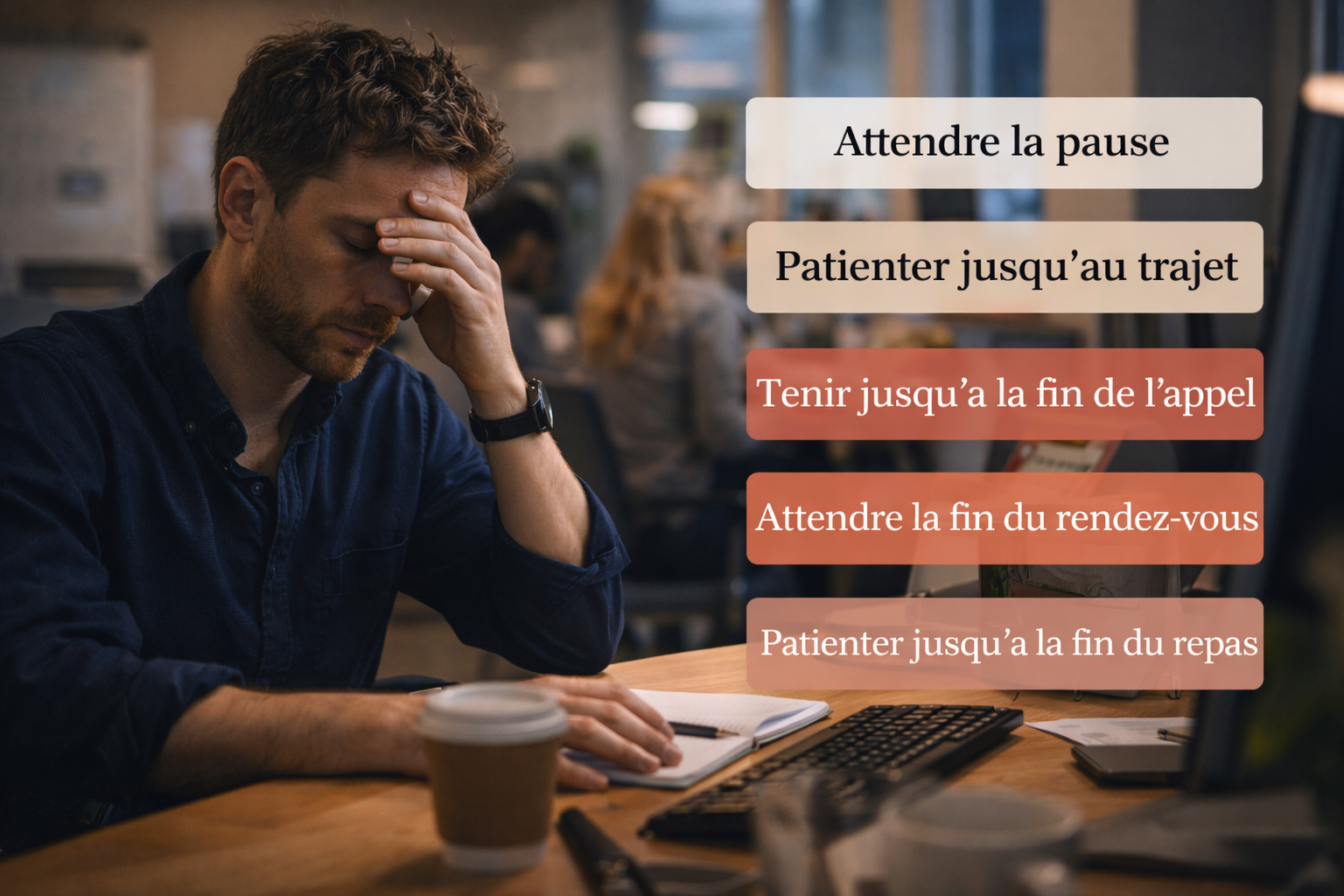
Waiting for the break at work
Work is one of the most common settings for this habit. We focus, we tackle one task after another, we manage deadlines, coworkers, and demands… and then the break becomes a goal in itself. Of course, taking a break isn’t a problem. What’s interesting is when it’s thought of first and foremost as the moment when we can finally smoke. We’re no longer just looking to catch our breath—we’re specifically waiting for the cigarette that will mark this break.
In this routine, certain mornings or afternoons feel almost like a journey. You hold out until 10:00 a.m. Then until noon. Then until the end of the day. Cigarettes then become the main punctuation mark in a time that, otherwise, seems harder to bear.
Hold on until the trip is over or until you get home
The car, the drive home from work, and the moment when you finally leave a confining place are also very powerful landmarks. For some smokers, the cigarette on the drive home isn’t just a habit—it’s a long-awaited release. It marks the end of an effort, the breaking free from a routine, and the transition to something else. It’s no surprise, then, that it’s so eagerly anticipated.
This type of cigarette is particularly revealing, because it clearly shows that the goal is not simply to smoke, but to alter one’s state of mind. One moves from a state of tension to a form of ritualized relaxation. The more this transition is repeated, the more significant it becomes.
Wait until the end of an appointment, a meal, or a phone call
There are also all those times when smoking just isn’t possible right away. A visit, an appointment, a family meal, a somewhat long phone call, a train ride, a social situation. In those moments, some smokers find themselves not fully present. Part of them is just waiting for it to end—not necessarily because they want to leave, but because they know that afterward, they’ll be able to smoke.
It’s a small detail, but a revealing one. When a cigarette begins to linger in the back of your mind during a moment, it takes up more space than you might think. It becomes a silent deadline that affects your attention, patience, and sometimes even your ability to be fully present.
Why this mechanism often goes unnoticed
Because it looks like a normal organization
The most troubling thing about this habit is that it seems almost logical. After all, everyone structures their day around landmarks: meals, breaks, commutes, the end of the day. Nothing seems strange at first glance. What changes is that, for smokers, some of these landmarks eventually become internally associated with cigarettes above all else. We don’t always articulate it clearly, but the day is organized around these moments.
Since it doesn’t seem like a constant emergency, we tend to underestimate the problem. We tell ourselves that we’ve got it under control. That we don’t think about it that much. That it’s just one habit among many. Yet this way of “holding out until” already reveals something important: cigarettes serve as a mental crutch.
Because smokers often believe they still have things under control
Many people don’t immediately see the problem, precisely because they manage to wait. They don’t feel overwhelmed by a constant craving. They tell themselves that they know how to be patient, that they can control themselves, and that they don’t smoke just anytime. But this apparent self-control sometimes masks something else: the fact that cigarettes remain central to several key moments of the day.
So you may feel as though you’re in control of your smoking, while letting the cigarette silently dictate your breaths, your transitions, and your little rewards.
Waiting can end up being more exhausting than you might think
Thinking regularly about the next cigarette—even discreetly—takes up mental space. It creates an underlying tension—a kind of constant anticipation. We don’t always realize it, because it’s part of our inner landscape. Yet this waiting is exhausting. It reduces spontaneity. It turns certain moments into mere stepping stones toward something else. It sometimes makes days feel heavier, because we go through them with the thought that we’ll have to hold out a little longer.
This fatigue is often underestimated. Smokers think cigarettes provide relief, but they sometimes forget all the time spent waiting for them. Yet this waiting, repeated day after day, also ends up taking a toll. It takes up space in one’s mind, in one’s habits, and in the rhythm of daily life. And the more ingrained it becomes, the more daunting quitting feels, because it feels like losing several points of reference all at once.
Why This Makes It Harder to Quit Smoking
When smoking becomes a fixed point in the day, quitting is no longer just about giving up a habit. It requires restructuring several aspects of daily life. Breaks no longer take the same form. Commutes no longer serve the same purpose. The end of a task no longer has the same signal. What seemed to be “just” a cigarette turns out to be a deeper part of one’s daily routine.
That’s why some people feel unsettled right from their first attempts. They discover that not having a cigarette leaves gaps at very specific moments: between tasks, after a meeting, on their way home, or after an intense moment. It’s not just a matter of willpower. It’s also a matter of shifting your habits.
Make room for other breaths
The good news is that these cues can be rebuilt. Not artificially or instantly, but gradually. Once you realize that you weren’t just smoking out of craving, but also to mark certain moments of the day, it becomes easier to imagine something else. A real break. A change of scenery. A different kind of break. A different rhythm.
Often, the hardest part isn’t giving up cigarettes themselves, but learning to stop thinking about them throughout the day.
The anti-smoking laser: a tool to break this subtle habit
Once this habit of “holding out until the next cigarette” is firmly established, it becomes difficult to break on your own, because it has crept into so many moments of daily life. It’s not limited to a one-time craving. It’s part of your inner rhythm. In this context, support can really help break this subtle pattern, without making quitting feel like a constant struggle.
The anti-smoking laser appeals precisely to people who want to break free from these automatic habits in a more peaceful way. The goal isn’t just to cut out a cigarette, but to regain a freer relationship with one’s days, breaks, and transitions. When you no longer look forward to a cigarette as a reward or as anticipated relief, something changes profoundly in the way you experience everyday life. You gradually stop holding on “until” the next cigarette. You begin to live fully in the moment again, without depending on the next cue.
Rediscover a day that no longer revolves around the next cigarette
Deep down, this silent habit says a lot about the place tobacco has come to occupy over time. Not necessarily in a dramatic way, but in a subtle, steady, almost invisible way. The cigarette becomes a milestone, a promise, a welcome break. And that is precisely why it’s helpful to put this mechanism into words—not to make anyone feel guilty, but to better understand what’s really going on.
Once you realize that your day has started to revolve around your next cigarette, it becomes possible to imagine something else. Breaks that feel less forced. Transitions that are less dependent on the cigarette. A rhythm less dictated by waiting. And that’s often where a true sense of freedom begins: when you’re no longer going through your day already thinking about the next time you’ll be able to smoke.


