
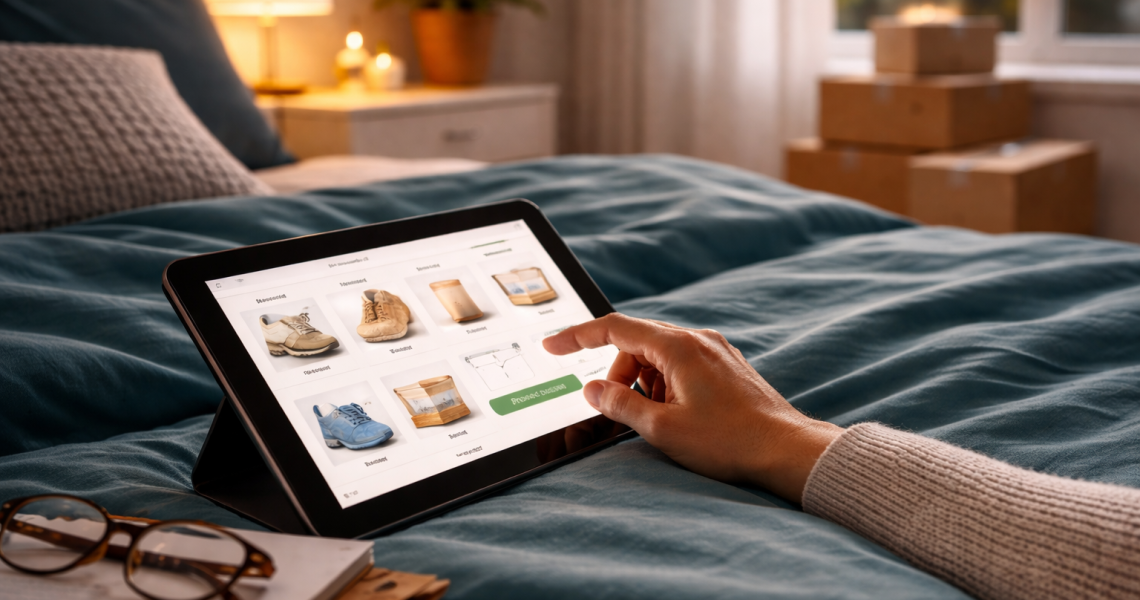
Some purchases fulfill a clear need. You replace a broken item, order something useful, or make a purchase you’ve been planning for a long time. And then there are the others. The ones we make on a slow evening, between notifications, after a busy day, telling ourselves we deserve “a little something.” It’s not necessarily anything spectacular. A few items in a cart, a quick order, a sale that comes at just the right time, a whim that seems harmless. Yet behind these small online purchases, there’s sometimes more at play than just the simple pleasure of shopping.
Many people aren’t just looking to make a purchase. They’re looking to unwind, treat themselves, regain a sense of lightheartedness, fill a void, or relieve pent-up stress. Clicking “checkout” then becomes a brief respite. A brief, discreet, almost mundane relief—but one that often says a lot about the state of mind in which we end our days. The point isn’t to demonize impulse buying. It’s to understand when it stops being an occasional choice and becomes a way to feel better—or at least to try to.
When Buying Is About More Than Just Ownership
Relief often comes even before delivery
What’s interesting about shopping online is that the sense of well-being often sets in long before the item actually arrives at your doorstep. For some people, the most satisfying moment isn’t opening the package. It’s the search, filling the cart, and placing the order. It’s that brief moment when something clicks. As if the very act of choosing, clicking, and confirming already helps relieve the pressure.
This mechanism speaks volumes. It shows that the object isn’t always the focus of the story. Sometimes what matters more is the act of buying itself. It’s a way to regain control after a difficult day. A reward we give ourselves without having to negotiate it with anyone. A moment when we finally decide on something simple, personal, and rewarding. The purchase then becomes less of an act of consumption and more of a small tool for emotional regulation.
A gift basket can sometimes fulfill more than just a material need
Let’s consider a very simple scenario. A person comes home late, tired, and mentally overwhelmed. She doesn’t feel like thinking, doesn’t feel like facing yet another to-do list, and doesn’t feel like dealing with that lingering sense of tension either. They open an app, browse a few articles, make a quick comparison, and add an item of clothing, a home decor piece, a wellness product, or an accessory they hadn’t planned to buy that very morning. For a few minutes, her focus shifts. She’s no longer consumed by the exhaustion of her day. She’s immersed in a pleasant prospect.
In this case, the purchase serves several purposes at once: it takes your mind off things, provides a small, immediate pleasure, restores a sense of control, and sometimes even offers a positive outlook for the next day. This isn’t “serious” in and of itself. But when this pattern repeats itself frequently, it’s worth taking a closer look.
These little purchases often reflect how exhausting our evenings have been
Evening is the perfect time for subtle gestures of appreciation
It’s no coincidence that many orders are placed in the evening. The day is over, the pressure eases, and so does our energy. We’re more vulnerable to habits that promise quick relief. For some, it’s sugar. For others, a drink, a cigarette, endless scrolling… and for still others, an online shopping cart that fills up almost automatically.
In the evening, we’re less able to cope with frustration. We’re more inclined to treat ourselves, to mark the end of the day, to make up for what’s been too heavy, too restrictive, too intense. A purchase can then serve as a silent reward. We tell ourselves we’ve earned it. We don’t necessarily put it that way, but the thought process is there: “I held on, I handled it, I took it in stride—now I’m treating myself to something.”
“Just a quick thing”: the phrase that puts people at ease
Purchases that take up too much space rarely start with big-ticket items. Instead, they creep in through small, all-too-familiar justifications: “It’s no big deal,” “It’ll make me happy,” “I’m hardly spending anything,” “It’s useful anyway,” “I’ll see how it goes.” The problem isn’t the amount alone. It’s the role that this small purchase begins to play in the rhythm of daily life.
It’s perfectly possible for someone to order small items regularly without ever feeling like they’re going overboard. And yet, if each order serves to relieve the same tension, fill the same void, or reward the same exhaustion, it’s no longer just about occasional pleasure. It’s a behavior that’s starting to function as a crutch.
Rewarding oneself, calming down, feeling fulfilled: what we sometimes seek through shopping
Many purchases have less to do with desire than with one’s inner state
We often assume that a purchase is driven by a specific desire. In reality, many small purchases say more about a person’s inner state. Fatigue. Boredom. Mental overload. Loneliness. A need for comfort. A need for something new. A need for a quick, small boost. The item itself becomes secondary. What matters is how the act of buying makes us feel for those few minutes.
This is very evident among people who order frequently without really using what they receive afterward. Some even forget what they bought. Others look forward to the package mainly as a small highlight in an otherwise rather dull week. Still others feel a great sense of relief when placing an order, but much less so upon receiving it. This discrepancy is telling, because it clearly shows that the purchase was primarily a response to stress rather than a real need.
Shopping to Avoid Dealing with Our Feelings
Then there are the purchases that happen during those vague moments. A dull evening. A setback. An argument. A disappointment at work. A dip in mood with no obvious reason. In those moments, some people open a website or app not because they want something specific, but because they don’t want to be left alone with how they’re feeling. The shopping cart serves as a distraction, a mini-project, a promise, a rewarding diversion.
This is where the act of purchasing becomes interesting to observe. It’s not just about bringing an object into one’s life. It’s about avoiding discomfort or masking a more unpleasant sensation. And the more discreet this mechanism is, the more likely it is to take hold without anyone noticing.
At what point does it start taking up too much space?
It’s not just the frequency that matters
Anyone can make an impulse purchase or treat themselves without it raising any questions. The key issue isn’t just the number of orders. It’s the dependence on the relief that comes from the act itself. When someone feels they often need to buy something to feel better, reward themselves, or calm down, that’s already cause for concern.
There are a few signs that might tip you off. Frequently visiting online stores when you’re stressed. Filling up a shopping cart without really needing anything, just to feel better. Receiving packages that, once opened, don’t really add much to your life. Promising yourself you’ll be more careful… only to start again the next time you have a rough day. These aren’t necessarily dramatic signs, but they point to a habit that’s trying to take hold.
Shopping becomes a coping mechanism
Once a behavior consistently recurs in certain emotional states, it takes on a different significance. It’s no longer just about consumption. It’s about regulating something. And that’s where the risk grows: not necessarily the risk of an extreme situation, but the risk of no longer really knowing how to unwind in any other way. The online shopping cart becomes a shortcut. And like all emotional shortcuts, it’s tempting because it’s quick.
Take Back Control Without Feeling Guilty
The real issue isn’t about giving up all pleasure
When faced with this kind of habit, the wrong response would be to moralize about everything. The problem isn’t enjoying treating yourself or ordering something every now and then. The problem arises when the behavior becomes almost automatic—and especially when it always serves the same hidden purpose. The goal, therefore, isn’t to constantly monitor yourself, but to understand what’s going on the moment you feel the urge to buy something.
Asking yourself a simple question can already make a big difference: What do I need right here, right now? An object? Or some relief, a reward, a break, a little bit of improvement? This question doesn’t necessarily stop you from making a purchase, but it brings a little awareness to a situation where there was previously only a reflex.
Facing Up to His Nightlife
Often, these purchases say less about our relationship with money than about our relationship with fatigue and the need for compensation. Someone who frequently fills an online shopping cart doesn’t necessarily describe themselves as a “compulsive shopper.” Instead, they might recognize themselves in statements like: “I end my days feeling drained,” “I need something to help me unwind,” “I have a hard time relaxing without filling the void,” or “I need to feel rewarded.”
When we start to look at things from this perspective, a purchase becomes a useful signal once again. It shows that a need is trying to make itself heard. And that’s often the starting point for change.
Ear laser therapy: a form of support when certain automatic behaviors become too overwhelming
Even though this article isn’t solely about smoking, it touches on a reality found in many repetitive behaviors: when an action is repeatedly used to calm, compensate, fill a void, or provide relief, it eventually takes up more space than we realize. This can apply to smoking, of course, but also to sugar, snacking, or other daily habits.
It is in this context that auricular laser therapy can be a valuable tool. This gentle approach appeals to people who feel that a certain behavior has become an almost automatic response to tension, stress, or a sense of emptiness, and who wish to rediscover a more serene sense of freedom. When a habitual response has long served as a reward or crutch, having support often makes it easier to navigate the change with greater clarity and less inner conflict.
What These Little Evening Baskets Really Tell Us
Deep down, these purchases often reveal one simple truth: many people don’t so much lack material possessions as they do genuine moments of respite in their days. They lack breaks that aren’t immediately filled with something else. They lack rewards that don’t always come with a click. Sometimes they lack a moment that truly belongs to them. The online shopping cart then becomes a subtle language of everyday life. It speaks to fatigue, the need for comfort, and the desire to regain control.
Understanding this doesn’t mean judging yourself. Above all, it helps you see a little more clearly what you’re trying to soothe. And that’s often when something changes: when we stop believing that we simply “wanted to buy” something, and start to see what that small gesture was revealing about our daily lives.


