
Stress and Cigarettes: Why Smoking Only Seems to Relax You
MyLaserTabac Practical Guide
The feeling of relaxation after a cigarette is real, but interpreting it that way is misleading. Much of the relief comes from the temporary disappearance of the craving caused by the previous cigarette. The smoker thus briefly returns to a more neutral state, but then the nicotine levels drop and the tension returns. This cycle can give the impression that smoking relieves stress, when in reality it helps to perpetuate it.
| KEY POINTS: Cigarettes primarily relieve nicotine cravings in the short term. Emotional stress and nicotine cravings can overlap. A quick coping technique should be available before the craving becomes too strong. Persistent anxiety disorders require professional help. |
The Nicotine Cycle: Cravings and Relief
After smoking a cigarette, nicotine quickly stimulates the brain. When nicotine levels drop, irritability, tension, and impatience may set in. Smoking again reduces these feelings, reinforcing the idea that cigarettes are relaxing. This learning mechanism is powerful because it repeats itself several times a day.
Distinguishing Between Three Types of Stress
Physical Deprivation
It often occurs at regular intervals and is accompanied by a strong urge to smoke.
Situational Stress
It is related to a conflict, an excessive workload, bad news, or a fear.
Chronic Stress
It persists even when withdrawal symptoms are not present. It may require specific treatment, especially if it interferes with sleep, work, or relationships.
Techniques That Take Less Than Five Minutes
- Breathing: Inhale for four seconds, exhale for six seconds, and repeat for two minutes.
- Physical release: Walk briskly, climb a flight of stairs, or stretch your shoulders.
- Sensory Anchoring: Name five things you see, four you touch, and three you hear.
- Writing: Write down the problem and the next useful step.
- Social break: Call or send a message instead of going to the smoking area.
Develop a plan for high-risk situations
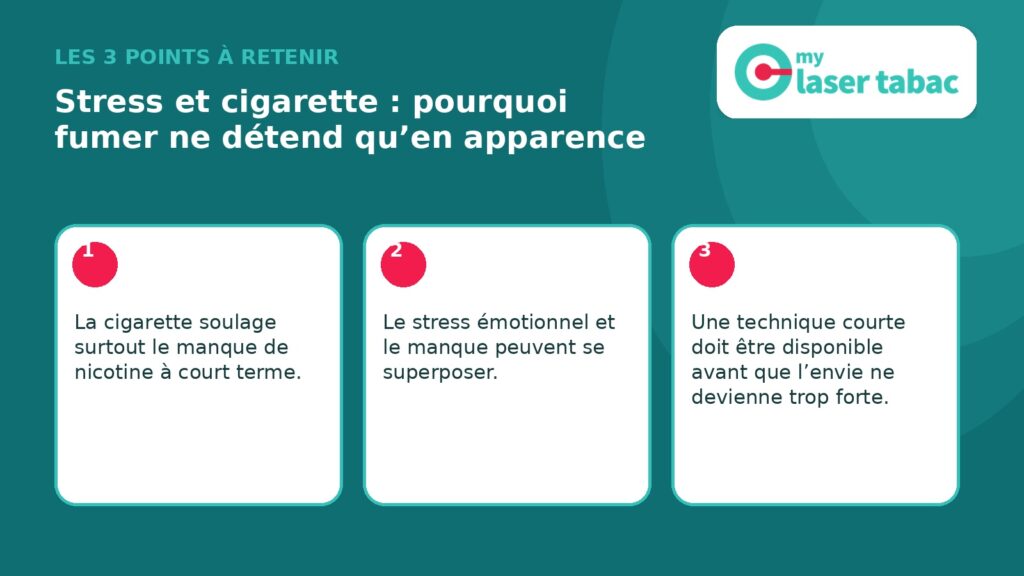
MyLaserTabac infographic summarizing the key points of the article “Stress and Cigarettes: Why Smoking Only Seems to Relax You”
Identify the moments when stress and smoking are most closely linked: a difficult meeting, driving, an argument, the end of the day, alcohol, or fatigue. For each one, define a specific response. A vague plan—“I’ll control myself”—is unreliable. A concrete plan—“After a tense meeting, I’ll go downstairs for a five-minute walk with a bottle of water”—is much easier to carry out.
What role does laser auriculotherapy play?
Some people are looking for a quit-smoking ritual and non-medication-based support. The MyLaserTabac session can be part of this process, focusing on triggers and replacement strategies. Results are not guaranteed, and scientific evidence regarding laser therapy remains limited. If you experience significant anxiety, consulting a doctor or psychologist should be your first priority.
Common Mistakes to Avoid
- Waiting for a major crisis to practice a breathing technique.
- Confusing relaxation with the disappearance of longing.
- Increase your intake of alcohol, coffee, or sugar to compensate.
- Do not treat a genuine anxiety disorder.
- Judging oneself harshly after giving in to a craving or making a slip-up.
Conclusion
Achieving lasting change requires understanding the mechanisms involved, preparing for high-risk situations, and seeking help when needed. The laser auriculotherapy offered by MyLaserTabac can be used as a non-invasive complementary treatment, with results varying from person to person. For personalized advice, contact your nearest MyLaserTabac center and, if your situation requires it, a healthcare professional.
| Please note: This article provides general information. It is not a substitute for medical advice. If you experience chest pain, unusual shortness of breath, neurological symptoms, psychological distress, or persistent symptoms, contact a healthcare professional immediately. |
SEO FAQ
Why am I more stressed at the beginning of my time off?
Withdrawal symptoms, changes in habits, and the fear of relapse can temporarily increase blood pressure.
Does stress eventually decrease after quitting?
Many former smokers report feeling more stable once the nicotine-withdrawal cycle has been broken, but this varies.
Can breathing really curb a craving?
It doesn’t always eliminate the urge, but it reduces the physical arousal and allows you to let the wave pass.
When should you see a doctor?
When anxiety is intense, persistent, debilitating, or associated with depression, panic attacks, or suicidal thoughts.


