
Health • Recovery • Alcohol • Physical Activity
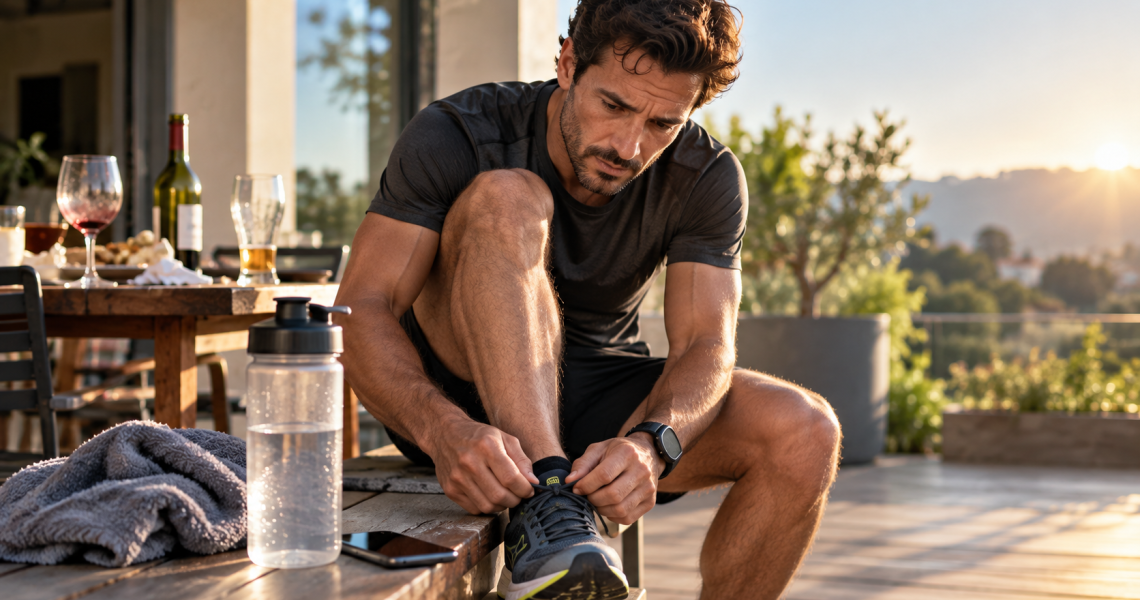
Illustration: Physical activity the day after a night of drinking.
Running ten kilometers the day after a night out, working up a sweat for an hour at the gym, or scheduling a long bike ride can make it feel like you’re starting over. On social media, we’re even seeing challenges like “one drink = one kilometer.” The idea is appealing: since alcohol provides calories and tires the body, physical exertion would supposedly cancel them out. The problem is that the body doesn’t function based on a simple calculation of calories.
Exercise remains one of the best ways to stay healthy. It improves cardiovascular fitness, long-term sleep quality, mood, and overall well-being. But it does not neutralize ethanol that has already been absorbed, nor does it counteract its effects on the liver, the brain, sleep, or muscle recovery. The real question, then, isn’t how many kilometers you’d have to run to “undo” a night of drinking, but what physical activity can actually do after drinking—and what it can’t fix.
Why is the idea of “offsetting” alcohol with exercise so appealing?
The reasoning seems logical: a night out was more indulgent than expected, so you run more the next day. This logic is reinforced by smartwatches and apps that translate everything into numbers: calories burned, kilometers traveled, heart rate, elevation gain. It becomes tempting to turn health into a spreadsheet.
In psychology, this mechanism is similar to what researchers call “moral licensing”: after engaging in behavior perceived as beneficial, some people feel more justified in engaging in less favorable behavior. The opposite also holds true: after overindulging, people seek out a “virtuous” action that would help restore balance. This is precisely the driving force behind challenges where participants run as many kilometers as the number of drinks they’ve consumed.
The problem is that alcohol doesn’t just affect the body through the calories it provides. It temporarily affects the nervous system, metabolism, sleep, fluid balance, and several recovery mechanisms. Exercising can be beneficial for overall health, but it doesn’t reverse these effects.
What Exercise Can Improve… and What It Can’t Undo
| Sports can help… | Sports can’t… |
| improve cardiovascular health in the long term | significantly speed up the elimination of alcohol |
| support your mood and reduce stress | eliminate the effects of alcohol on the liver or the brain |
| promote better sleep when practiced regularly | Instantly recover from a night disrupted by alcohol |
| become a useful tool in certain addiction treatment programs | turn excessive consumption into safe consumption |
| help restore a more balanced routine | eliminate the risk associated with dangerous driving or activities while under the influence of alcohol |
Sports and Alcohol: What Really Happens in the Body
Alcohol doesn’t leave the body through sweating
Sweating may give the impression that you’re “working off” the effects of the night. However, alcohol is primarily metabolized by the liver. Exercising does not speed up this process enough to help you sober up faster. An intense workout should therefore never be used as an excuse to resume driving or any activity requiring alertness and coordination sooner than recommended.
Muscle recovery may be less effective
Research on alcohol consumption after exercise reveals a more nuanced reality than simply “exercise is pointless.” While certain measures of strength or pain are not consistently affected, studies have observed a decrease in muscle protein synthesis and hormonal changes when alcohol is consumed during recovery. A systematic review published on the subject concludes, in particular, that muscle protein synthesis is reduced in several experimental protocols.
In other words, training hard and then drinking a lot is not the best strategy if your goal is to make progress, build muscle, or recover quickly.
Sleep is often the one thing that gets overlooked
Alcohol may help some people fall asleep, but that doesn’t mean it improves sleep quality. A night of drinking can disrupt sleep and impair recovery. Yet sleep plays a central role in performance, alertness, mood, and physical recovery. Recent research on sleep and sports reminds us that insufficient rest can impair performance and prolong fatigue.
Running very early in the morning after a short night’s sleep does not, therefore, “make up” for the lost sleep. In some cases, it makes more sense to opt for a walk, proper hydration, and true recovery rather than a very intense workout done out of a sense of guilt.
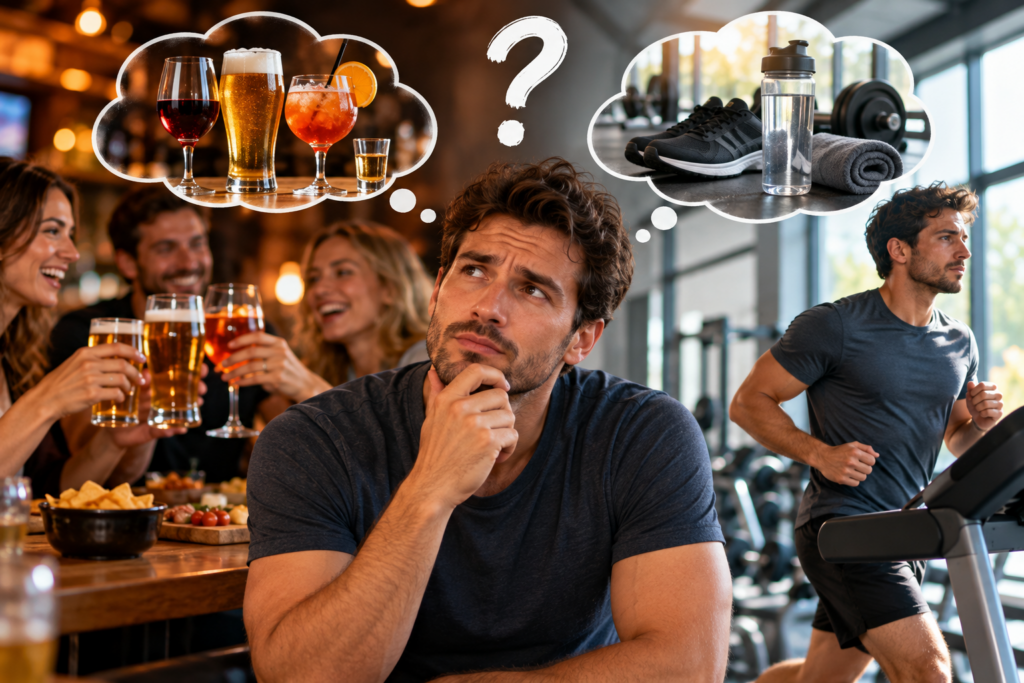
The pitfall: turning exercise into a means of compensation rather than a healthy habit.
Should you exercise the day after a night out?
It all depends on the amount consumed, your overall health, sleep, hydration, and the type of exercise planned. Light or moderate activity can be enjoyable when you’re feeling well. However, pushing yourself to do intense training despite nausea, dizziness, severe fatigue, or dehydration offers no particular benefit and may increase the risk of feeling unwell or getting injured.
A few simple guidelines are helpful:
- Do not use exercise to try to “sober up” more quickly;
- wait until you have fully recovered before engaging in strenuous or technically demanding activity;
- Stay hydrated, eat, and get enough sleep before trying to perform at your best;
- opt for a low-impact activity if you’re very tired;
- Stop exercising and seek medical advice if you experience any unusual or severe symptoms.
Can the calories in alcohol at least be “burned off”?
From a purely caloric standpoint, physical activity burns a lot of calories. But reducing alcohol to its caloric content is misleading. Two drinks containing the same number of calories do not necessarily have the same effect on the body.
The risks associated with alcohol increase with the amount consumed over a lifetime. Santé publique France emphasizes that there is no such thing as risk-free alcohol consumption and recommends the following guidelines for risk reduction: no more than 10 standard drinks per week, no more than 2 per day, and days with no alcohol consumption.
So burning 500 calories by running after a night out doesn’t turn alcohol consumption into a neutral event. Exercise does have health benefits, but these are in addition to the health risks; they don’t automatically eliminate the risks associated with excessive drinking.
When exercise, on the contrary, becomes a real ally in reducing alcohol consumption
It’s important to distinguish between two things: exercising to “pay for” your drinks and using physical activity as a positive habit as part of a lifestyle change.
On this second point, the literature is much more interesting. Research in the field of addiction shows that physical activity can be incorporated as a complementary intervention for certain individuals with an alcohol use disorder. It can support mood, physical fitness, and well-being. Some studies have also observed a reduction in cravings after a session of moderate exercise among a subset of participants.
This does not make exercise the only treatment for addiction. But replacing the “automatic pre-drink” ritual with a walk, a scheduled workout, or a group activity can give daily life a new structure. The difference is fundamental: exercise is no longer a punishment for drinking; it becomes a tool to support change.
Alcohol, tobacco, and parties: these habits can reinforce one another
In real life, alcohol and cigarettes are often linked. Someone who smokes only a few cigarettes during the week may find that they smoke more frequently during a night out. Alcohol reduces alertness and can make it harder to stick to a decision made with a clear head.
For those who want to quit smoking, it can be helpful to prepare for those first few evenings without cigarettes: let loved ones know in advance, avoid spending too much time in smoking areas, have a response ready when offered a cigarette, and, if necessary, temporarily limit alcohol consumption when it acts as a trigger.
The MyLaserTabac website also features a wealth of content onquitting smoking, the habits associated with smoking, and various ways to prepare for quitting.
Among the complementary approaches offered by the network is the anti-smoking laser, which is based on low-intensity laser stimulation of the ear. This method is presented as a tool to support behavior change; it should not be considered a substitute for medical supervision or validated treatment when these are necessary.
What if it becomes difficult to control your alcohol consumption?
There’s a big difference between an occasional night of heavy drinking and regular drinking that has become difficult to control. If alcohol plays a major role in your day—if you need it to sleep, to calm tremors, or to feel “normal”—the question is no longer which sport to play the next day.
In this situation, it is recommended to seek medical or addiction counseling. In some physically dependent individuals, abruptly stopping alcohol consumption can cause severe withdrawal symptoms, including tremors, confusion, hallucinations, or seizures. Alcool Info Service notes that delirium tremens is a rare but serious complication that may require urgent hospitalization.
Physical activity can play a role in recovery, but it serves as one complementary tool among others: medical care, psychological support, treatment when necessary, social support, and lifestyle changes.
How can you develop a healthier relationship with sports and alcohol?
The first change often involves letting go of the idea of punishment. A night out with friends doesn’t need to be “paid off” by running ten kilometers, just as a workout doesn’t earn you a “credit” of drinks to spend that evening.
A more balanced relationship with alcohol hinges on a few simple questions: Do I drink because I want to, or because the situation pushes me to? Does alcohol interfere with my sleep, my workouts, or my goals? Do I exercise because I enjoy it, or mainly to make up for what I’ve eaten or drunk?
These questions are more useful than counting calories. They help identify the moment when two behaviors—which are ordinary on their own—begin to revolve around guilt and compensation.
Conclusion: Exercise protects your health, but it doesn’t cancel out the effects of alcohol
Exercising regularly is still an excellent choice. Physical activity improves many health indicators and can be a real help when you want to change certain consumption habits.
But the key message is simple: no amount of running, weight training, or cycling can make up for a night of heavy drinking. It doesn’t help the alcohol leave your system any faster, doesn’t turn a restless night’s sleep into a restful one, and doesn’t make excessive drinking safe.
The best use of exercise, then, is not as a form of compensation. It’s about building a routine that gradually improves sleep, mood, physical fitness, and self-confidence—without needing to “earn” a drink or “pay off” the one from the night before.
FAQ: Sports and Alcohol
Does exercising help your body break down alcohol faster?
No. Alcohol is primarily metabolized by the liver. Exercise and sweating do not speed up its elimination enough to help you sober up faster.
Can you go for a run the day after a night of drinking?
Moderate physical activity is acceptable if you are well-rested, well-hydrated, and have no significant symptoms. If you experience dizziness, nausea, severe fatigue, or dehydration, it’s best to rest and postpone intense exercise.
Does exercise offset the calories in alcohol?
It increases energy expenditure, but it does not negate alcohol’s other effects on sleep, the liver, the brain, or recovery. Caloric balance, therefore, does not fully capture the risk.
Can physical activity help reduce alcohol consumption?
It can be a helpful tool: it provides structure to the day, improves mood, reduces stress, and, in some patients, temporarily reduces cravings. However, it is not a substitute for addiction treatment once an addiction has taken hold.
Why do we sometimes smoke more when we drink?
Alcohol can reduce alertness and trigger habitual behaviors associated with social gatherings. For a smoker trying to quit, anticipating these situations can make it easier to stick to the decision to quit.


